
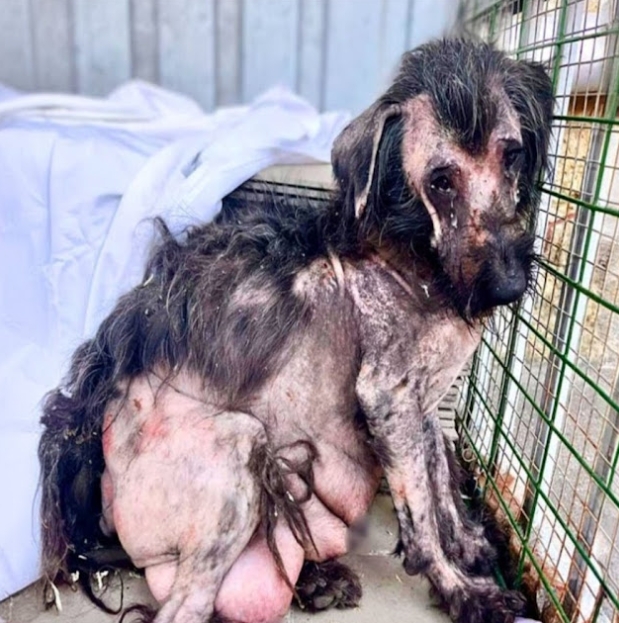
We first saw her by the roadside, a lone figure pacing in restless circles, her slender frame trembling with exhaustion and fear. Dust clung to her coat, and her weary paws left faint prints in the dirt as she moved with frantic purpose. But it was her eyes—wide, searching, and filled with a depth of sorrow no words could ever fully convey—that told the truth. She wasn’t simply wandering; she was looking. She was desperately, painfully searching for something she could not accept had been taken from her.
Her puppies were gone.
Someone had stolen them, torn them from her before they had even opened their eyes, before they had felt the full warmth of the world or the safety of a mother’s presence. And she—left behind and helpless—carried that grief in every ragged breath, every trembling step, every soft whine that escaped her throat as she continued her hopeless search along the roadside.
It was a grief no mother, in any species, should ever have to endure.

When we first approached her, she backed away, torn between fear and desperation. Her ribs showed through her thinning fur, yet her mother’s instinct drove her to continue searching, even as her body threatened to give out beneath her. We could have walked past, told ourselves that this wasn’t our responsibility, that nature or fate or circumstance had simply taken its course. But compassion doesn’t allow for indifference, and her pain was impossible to ignore. So we searched with her.
We combed the roadside, the ditches, the fields nearby. We called out softly, hoping against hope that a miracle might return what she had lost. But the fields were silent, and the world offered no solace. The puppies were gone—unreachable, taken for reasons we could neither understand nor explain. The truth settled like a weight in our chests: though we could search for hours, for days, even for weeks, we could not bring them back to her.
All we could offer was safety. Comfort. A chance, however small, for healing

With gentle words and slow movements, we coaxed her into the car. Her sadness was unmistakable. Even as she sank into a soft blanket, her eyes remained fixed on the window, scanning the landscape outside as if her babies might appear at any moment. We brought her to our shelter, not because we could erase her suffering, but because we refused to let her endure it alone.
The early days were the hardest. She ate only when coaxed and slept fitfully, often waking suddenly and lifting her head as if she had heard a familiar cry. Her body healed quickly under the care of our veterinarians, but her heart lagged behind. She would wander the corners of her kennel, sniffing at every space as though searching for the scent of her lost pups. Even when volunteers sat beside her, offering treats and gentle strokes, she often looked past them—her gaze drifting somewhere far away, somewhere filled with memories of tiny bodies nestled against her, warm and safe.
But healing—true, emotional healing—rarely happens all at once. It begins quietly, in small, almost imperceptible ways.

The first shift came when she allowed her head to rest in a volunteer’s lap. Her breathing slowed, her muscles relaxed, and her eyes—still sad, but softer—closed for a moment of peace. Later, she accepted a toy. Then she brightened at the sight of a familiar face. Little by little, she began to form genuine bonds with the people who stayed by her side, offering not just food and shelter but companionship, understanding, and patience.
Her transformation was slow, but it was real. In time, she learned that the world could offer kindness as well as pain. She discovered joy in simple things: a warm bed after months of cold nights, a gentle hand resting on her back, a friendly voice calling her name. The weight of her loss never fully disappeared, but it no longer crushed her spirit. She had survived something unimaginable, yet she remained gentle, trusting, and open to love. Her resilience—quiet, steady, unwavering—left an impression on everyone who cared for her.

When a family came across her story, it touched them deeply. They saw her not as a broken animal, but as a survivor with a courageous heart. Her journey resonated with them—the sorrow she had endured, the hope she had clung to, the trust she had rebuilt piece by piece. They felt something profound, something immediate: she belonged with them.
The day they arrived at the shelter, she approached them cautiously at first. But within minutes, something shifted. She leaned into their touch, her eyes softening in a way we hadn’t seen before. She seemed to understand, in a way only animals can, that these were her people—that they would not abandon her, that they would give her what life had once denied her: a safe place to belong, and love without conditions.
Watching her step into her new life was bittersweet for us. We had held her through her grief, witnessed her pain, and celebrated each small victory as she began to heal. Letting her go felt like saying goodbye to a chapter of heartbreak and hope intertwined. But seeing her walk out the shelter doors with her new family—tail wagging gently, head held higher than ever—filled us with something else entirely.
It felt like closure. Not the kind that erases the past, but the kind that honors it while embracing the future.
In her new home, she is cherished. She enjoys warm beds, loving arms, daily walks, and a family that sees her not for what she lost, but for who she is: a resilient, gentle soul with a capacity for love that survived even the deepest pain. Her story stands as a reminder that trauma does not define a life. That healing is possible. That compassion creates miracles quietly, day by day, through simple acts of care.

Most importantly, her journey reminds us that even after devastating loss, happiness can still be found—not by forgetting what was lost, but by allowing new love to take root where grief once lived.
Her story began with sorrow, but it did not end there. It became a testament to the enduring strength of a mother’s heart and the transformative power of human kindness. And though she can never reclaim what was taken from her, she has gained something just as precious: a family who sees her, understands her, and loves her without hesitation.
A second chance.
A home.
A life filled with warmth instead of longing.
And that, in the end, is its own kind of miracle